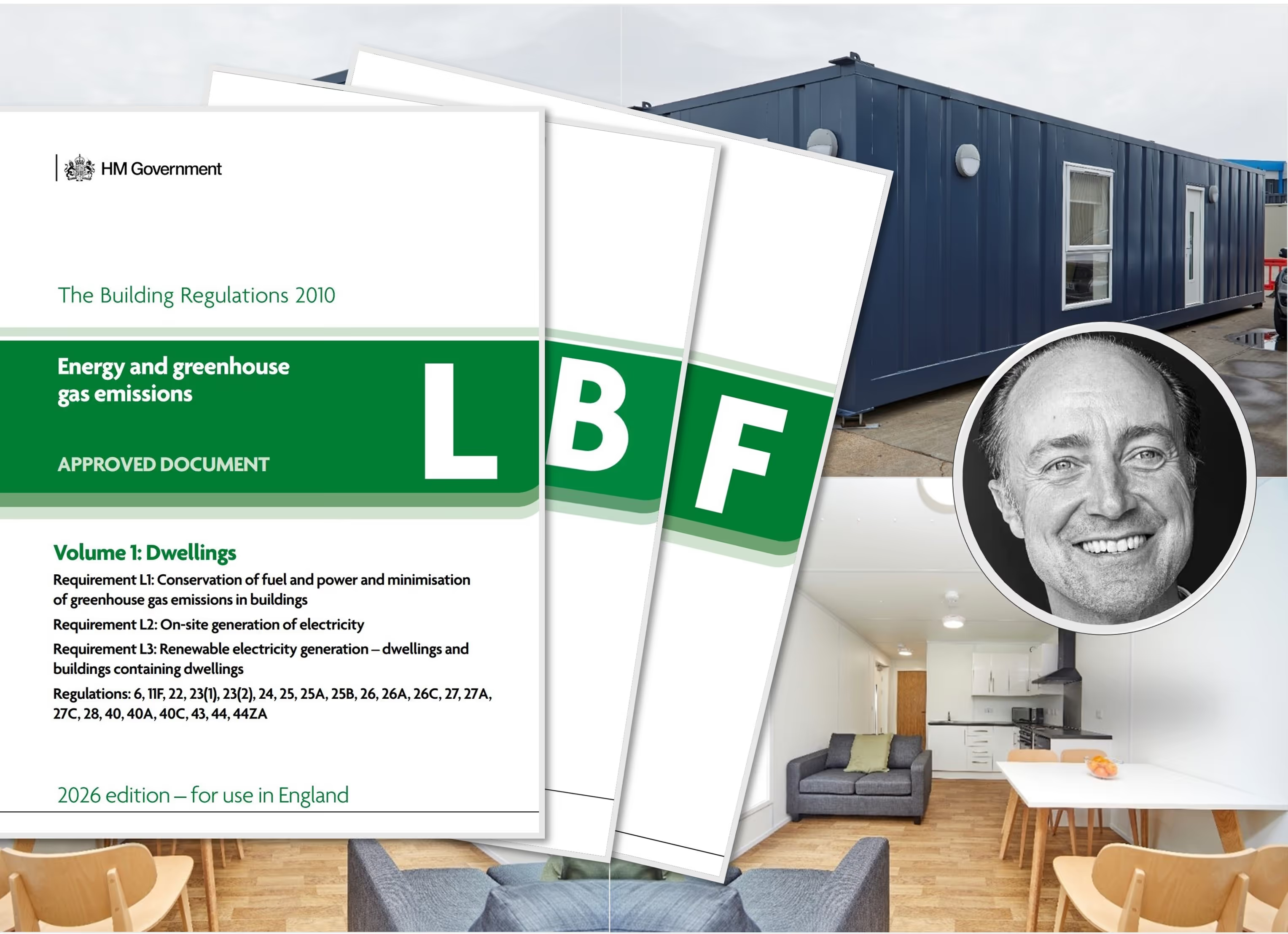
Innovating to meet today’s urgent housing crisis: developing modular temporary accommodation that meets and exceeds residential building regulations

23 April 2026
The UK’s leading innovator in temporary modular accommodation explains how its building regulations compliant units are helping councils reduce costs while delivering safe, dignified housing for people facing homelessness.
Giles Donovan, co-founder of Boost TA
Northampton-based Boost TA is providing an innovative solution to local authorities’ growing need for quality temporary housing, offering a cost-effective alternative to private rented accommodation, extended stays in hotels, and B&B's.

Boost’s purpose-built modular accommodation units are the first of their kind to have been designed and manufactured to meet and exceed all building regulations for residential use, combining high performance with practical, value-engineered design.  

Unlike many forms of temporary accommodation, they are designed from the outset to function as homes, and to meet today’s rigorous residential standards, rather than as alternative short-term stopgaps.

As a result, they avoid common issues such as poor energy efficiency, damp and mould that plague much of the UK’s older housing stock and provide a better solution than adapted commercial use units and structures. They also offer the potential to be used as longer-term rental accommodation, enabling councils to recoup costs within a relatively short period.

Giles Donovan, co-founder of Boost, explains: “We set out to fundamentally reimagine the design of modular accommodation units to offer rapid deployment of high quality, cost saving temporary accommodation. Working closely with the manufacturer, we explored the smartest and most cost-effective design solutions to create a model that delivers both high quality and excellent value for local authority clients.”

This value-focused approach to addressing the financial pressures due to the lack of suitable, cost-effective temporary accommodation with a high-quality solution that can be rapidly scaled, has driven growing demand from local authorities.

Boost is currently manufacturing 108 units at its Yorkshire facility. These will be delivered to an East Midlands local authority in July, providing safe, suitable accommodation for people in need by September.


A fabric-first approach

To meet the requirements of residential building regulations, Boost has adopted a fabric-first approach to construction, delivering air tightness of 2.5 m³/(h·m²) @ 50Pa.

“We know how important the fabric of a home is in ensuring comfort throughout the year,” says Giles. “We’ve focused on air tightness and insulation to ensure our units retain heat in winter and stay cool in summer, creating safe, quiet and comfortable places to live, while delivering strong value for money.”

As a result, Boost’s units exceed required standards for acoustic performance, energy efficiency and ventilation, without driving up costs.


Outstanding energy efficiency

Boost’s units achieve an A-rated Energy Performance Certificate (EPC), supported by an all-electric, energy-efficient design. Photovoltaic (PV) panels on the upper roofs feed into a centralised battery system, helping to reduce running costs by producing over 50% of the typical energy requirements.

“Achieving an EPC A rating required a focus on solutions with a positive benefit to the building regulations metrics and a low overall cost point. It means our units are much more efficient to run than the forecast for new homes by 2030 yet at a lower cost than current practice with M&E solutions” says Giles.
“We’ve been focused on future-proofing these units while keeping costs low, delivering high-quality temporary accommodation at the best possible price point.”

Rather than costly M&E such as an air source heat pump, Boost opted for an all-electric dry system. This avoids complex wet systems with water-filled radiators and pipework, reducing installation costs, maintenance requirements and helping to minimise the risk of mould.

Electric radiators are simple and cost-effective to replace, while necessary plumbing for bathrooms and kitchens is located behind a single removable panel for easy access and maintenance.

U-values, which measure how well a building retains heat, have been carefully optimised. Boost has achieved better than required u-values of 0.15in the walls without relying on more expensive materials or sacrificing internal area.


Ventilation and acoustic performance

The units are designed to provide effective ventilation and temperature control without the need to open windows, an important consideration in noisy urban environments.

“We’ve incorporated extraction systems that remove warm air and replace it with cooler, fresh air at a much lower cost than current M&E choices,” explains Giles.

These systems are also simple and cost-effective to maintain, while ensuring compliance with ventilation requirements even in high-noise locations such as inner-city areas.

To minimise sound transmission, the units use a timber frame design in which floors and ceilings are structurally independent, preventing noise transfer between levels. Adjacent units are also designed to reduce sound transmission side-to-side, creating a quieter living environment.


Exceeding safety standards

Boost’s temporary accommodation units are secure and designed to exceed fire safety requirements for residential buildings. A final fire safety assessment is currently underway, with early indications suggesting performance levels significantly above minimum 30-minute standards.

“We’re proud to have created a robust product that can help local authorities tackle homelessness in a way that is both secure, and with peace of mind around fire safety,” says Giles.
“Now that the design and manufacturing process has been refined and fully tested, we can reduce the time from planning approval to installation to less than seven months. We look forward to working with more local authorities in the months and years ahead.”

Share this post